Report on practical training at C-DOT
ABOUT C-DOT
BRIEF HISTORY : -
The Center for Development of Telematics (C-DOT) is the telecom technology development center of the government , It was established in August 1984 as an autonomous body. It was vested with full authority and total flexibility to develop state-of-the-art telecommunication technology to meet the needs of the Indian telecommunication network. The key objective was to build a center for excellence in the area of telecom technology .
ORGANIZATION : -
The management of C-DOT has a three-tier structure: -
The governing Council: provides policy guidelines and approves the annual budget of the center.
The Steering Committee: has the role of reviewing and monitoring the performance of the center.
The Project Board: is responsible for the implementation of C-DOT’s project and the day-to-day function of the center.
OBJECTIVES : -
q Work on telecom technology products and services.
q Provide solutions for current and future requirements of telecommunication and converged networks including those required for rural application.
q Provide market orientation to R & D activities and sustain C-DOT as center of excellence.
q Build partnerships and joint alliances with industry , solution provides, telcos and other development organizations to offer cost effective solution .
q Support telcos and service provides in the introduction of new technologies , features and services by optimal utilization of installed network.
MANPOWER : -
q Electronic Design automation (EDA) Tools for hardware and ASIC Design
q Case Tools for Development and testing of software
q Capative labs
q Computing center
q Pilot production plant
q Existing manpower –907
q Planned Manpower - 963
The Center has state-of-the-art development environment comprising client/ server network of RISC workstation, latest software development tools and very mature and effective development ad support methodologies, Extensive use is made of case tools, object-oriented methodologies, software metric etc.
The jobs have the latest test and measurement instrument, microprocessor development system and prototyping facilities.
ACHIEVEMENTS : -
q C-DOT Technology based system from 200 lines to 40,000 lines capacity in operation
q More than 30,000 C-DOT Exchange totaling approximately 25 million telephone lines installed and operational in field
q Deployed telecom equipment value of Rs.7500 crore
q Significant technology transfer and royalty earnings
q Technology development with low capital investment
q Wide porfolio technologies, products and solution
q Created large reservoir of technical manpower in telecom
q Established a technology transfer process for production by multiple manufacturers
The C-DOT DSS FAMILY
GENERAL
C-DOT DSS MAX is a universal digital switch can be configured for different application as local, transit or integrated local and transit switch. High traffic or capacity of 40000 lines as local exchange or 15000 trunks as Trunk automatic exchange.
The design of C-DOT DSS MAX has seen by a family concept because of it’s advantages like standardized components, commonality in hardware, field hardware that used minimum number of cards, standard cards, racks, frames, cabinets and distribution frames are used which facilitated flexible system growth that make C-DOR DSS MAX easy to maintain and highly reliable.
FLEXIBLE ARCHITECTURE
C-DOT DSS is a modular and flexible digital switching system which provides economical means of serving metropolitan, urban and rural environments. It include all important feature and compulsory services, required by the user with option of up gradation to add new feature and services in future. The architecture for the C-DOT DSS is such that it is possible to upgrade a working C-DOT Single Base Module.(SBM) or Multi Base Module (MBM)exchange to provide Integrated Services Digital Network (ISDN) service by adding minimum addition hardware modules while continue to having existing hardware units. Another factor of architecture Remote Switching Unit(RSU). Is support ISDN. This RSU provides switching facility locally even in case of failure of the communication path to the parent exchange.
The resources, which depend upon the number of terminal, are provided within the basic growth unit the Base Module. Base Processors are provided for handling call processing locally. In a small system application, these processors independently support call processing, exchange operation and maintenance function.
ARCHITECTURE OF C-DOT DSS MAX
C-DOT DSS MAX exchanges can be configured using four basic modules.
- Base Module
- Central Module
- Administrative Module
- Input Output Module
MDF SBM CONFIGURATION
Structure of C –DOT DSS MAX
HARDWARE ARCHITECTURE
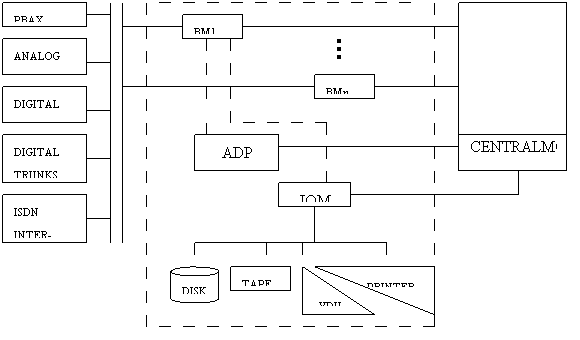
C-DOT MAX exchange can be configured using four basic modules:-
1.BASE MODULE(BM)
2.CENTRAL MODULE(CM) C
3.ADMINISTRATION STRATIVE MODULE(AM)
4.INPUT OUTPUT MODULE(IOM&IOP)
(a) BASE MODULE (BM) : -
The Base Module is the basic growth unit of the system . It interfaces the external world to the switch. The interfaces may be subscriber lines, Along and digital trunks. Each Base Module can interface up to 2024 terminations. The number of Base Modules directly corresponds to the exchange size. It carries out majority of call processing function and in a small exchange application, it also carries out operation and maintenance function with the help of Input-Output Module.
The Basic functions of a base modules are:-
- Analog to digital conversion of all signals on analog lines and trunks.
- Interface to digital trunks and digital subscriber.
- Switching the calls between terminals connected to the same Base Module.
- Communication with the AM via the CM for administrative(i.e. Call processing ) functions.
- Provision of special circuits for call processing support e.g. Digital
- Tones, announcement, MF/DTMF Senders/receivers.
- 6.Provision for local switching Unit(RSU) as well as in case of Single Base Module Exchange(SBM_RAX).
There are two types of Base Modules :-
- Single Base Modules(SBM)
2. Multi Base Module(MBM)
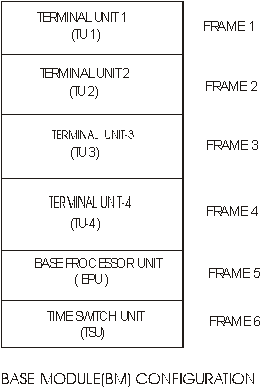
In SBM exchange configuration, the Base Module acts as an independent switching BM directly interface with the Input Output Module for bulk data storage, operations and maintenance function. Clock and synchronization is provided by a source within the BM. It is a very useful application for small urban and rural environments.
The Base cabinet houses total 6 frames:-
· Terminal Unit (TU, Top 4 Frames) system and provides connection to 1500 lines and 128 trunks. In such a configuration ,the
· Base Processor Unit ( BPU,5th frame)
· Time switch unit (TSU)
There are following four terminals units:-
1. ANALOG TERMINAL UNIT (ATU):-
The Analog Terminals Unit (ATU) is used for interfacing 128 analog termination which may be lines or trunks and providing special circuits as conference announcements and terminal tester. It consists of terminal cards, which may be a combination of Analog Subscriber Line Cards, Analog Trunk card & some Special Service Cards.
(a) Analog Subscriber Ling Cards : -
Two variants of subscriber line cards as LCC(Line Circuit Card) or CCM(Coin Collection Monitering) with interfaces upto 8 subscribers. Analog to digital conversion is done by per channel CODEC according to A-Law of Pulse Code Modulation so we can say that it for the subscriber connected for subscriber to exchange.
A unit has 16 line cards so 16*8=128 subscribers.
There are 4 unit so 4*128= 512 subscribers.
4 cards make 1 Terminal Group(TG) so TG = 4.
(b) Analog Trunks Cards :-
Analog trunk cards interface analog inter exchange trunks which may be of three types as TWT,EMT & EMF. These interfaces are similar to subscriber Line Cards, with only difference that the interfaces are designed to scan/drive events on the trunks as predefined signaling requirement.
(c) Signaling Processor Cards : -
SP Processes the signaling information received from the terminals cards. SP processes the signaling information consists of scan/drive function like original detection, answer detection, digit reception, reversal detection etc. The validated events are reported to Terminal interface controller for further processing.
(d) Terminal interface controller (TIC) Cards : -
TIC controls the four terminals group ( TG) of 32 channels and multiplex them to form a duplicated 128 channels, 8 mbps link towards the Time Switch. For Signaling information of 128 channels it communicates with signaling processor to receive/send the signaling event on analog terminations. It also uses to communicate with BPU.
(e) Special Service Cards : -
A Terminal unit has some special service cards such as Conference (CNF) cards to provide six party conference. Speech Samles from five parties are Terminal Test Controller (TTC) card is used to test analog terminal interfaces via the test access relays on the terminal cards.
Announcement controller card provides 15 announcement on board cast basis.
(2) DIGITAL TERMINAL UNIT( DTU ) : -
Digital terminal unit is used to interface digital trunks, i.e. used between the exchanges. one set of Digital Trunks Synchronization (DTS) Card along with the Digital Trunk Controller(DTC) card is used to provide one E-1 interface of 2mbps.
Each interface occupies one TG of 32 channels and four such interfaces share 4 TGs in a DTU. Here Terminal Unit Controller (TUC) is used of TIC and DSP cards. Out of 32 channels, 30 for voice communication and remaining two for Signaling and Synchronization.
In DTU 4 TGs are there so total number of unit are 4*30 = 120 units in DTU.
(3) # 7 or Signaling Unit Module(SUM) : -
It is used to support SS7 protocol handlers and some call processing function for CCS7 calls.
SS7 capability in C_DOT DSS MAX exchanges is implemented in the form of a SS& Signaling Unit Module (SUM).
The sum hardware is packaged into a standard equipment frame, similar to that of terminal unit. It is a module by itself and contains global resources. It interfaces with the Time Switch via Terminal Unit Controller (TUC) on a 128 channel PCM link operating at 8mbps.
ISDN
To support termination of BRI/PRI interfaces and implementation of lower layers of DSSI Signalling protocol. They are used as carriers to transport bulk volume of data. With the increasing use of internet access, the use of ISDN interface is likely to go up as it provides the reliable access to the user at the rate of 64/128kbps. It is of two types i.e. circuit switched voice and data and packet switched data. In circuit switch the traffic is routed through ISDN and is packet switched data the traffic is routed through PSPDN.
REMOTE SWITCH UNIT : -
In this time switch card BMs are replaced by Enhanced Switch Cards(ETS). It is used when the e exchange is at a far distance from the central module. It can modified BM via 2 mbps digital links. Analog and Digital trunk interfaces are also implemented in RSU to support direct perenting of small exchanges from RSU. Instead of perenting it to the main exchange. RSU is an autonomous exchange capable of local call completion. Only the even numbered BMs can be configured as RSU i.e. a maximum 16 RSUs are possible in C-DOT DSS MAX-XL and 8 RSUs in MAX-L Maintenance and operation function are handled by the host exchange.
Remoter Switch Unit Normal BMs
1.Tpe of connectivity used is 1.Type of connectivity is through E-1 data cables cards of 2mbps and E-3 cards of 32Mbs.
2. Contains Time Switch Cards. 2.Contains Enhanced Switch Card.
3. Situated at a Distance. 3. Should be in side of CM.
TIME SWITCH UNIT (TSU):-
Time Switch Unit (TSU) implements three basic function as time switching with in the Base Module, routing of control message within the Base Module and across Base Module and support services like DTMF circuit, answering circuit, tones etc. These functions are performed by three different functional unit, integrated as Time Switch Unit in a single frame. i.e.
SERVICE UNIT : -
It is integrated around three different cards as Tone Generator with Answering Circuit (TGA), Service circuit interface Controller (SCIC) and DTMF Controller, (MFC) Card. These three forms TGs towards Service Circuit interface (SCI). SCI multiplexes these TGs together with another terminal group from the Base Message. Switch (BMS) to form a 128 channel, 8 Mbps link & send it to the Time Switch.
BASE MESSAGE SWITCH (BMS) : -
Base Message Switch (BMS) route the control message with in the Base Module, across different Base Module and also Administrative Module via the Central Module. It is implemented around two cards as Message Switch Controller (MSC) with the Message Switch Device (MSD) with 16 HDCL links.
So total 22 HDLC channels are implemented for communication with the Base Processor, Time Switch Controller, Service Circuit interface Controller with in the BM. It transfer the message between the Base processor and these controllers.
To supports 8,00,000 BHCA,MSC AND MSD cards are replaced by a high Performance Switch(HMS) with high speed upto 750 Kbps, 32 bit microprocessor.
TIME SWITCH ( TS ) : -
The Time Switch complex is implemented using three different functional cards as multiplexer/demultiplexer (TSM),Time Switch (TSS) and Time Switch Controller (TSC). The Time Switch complex performs time switching with in the Base Module : -
- Four 128 channel multiplexed link from four different terminal units which may be any combination of ATU,DTU,#7SU AND ISTU.
- One 128 channel multiplexes BUS from the Service Circuit interface Controller (SCIC) in the Time Switch Unit.
- Three 128 channel link to support on board three party conference circuit (3*128).
BASE PROCESSOR UNIT :-
Base Processor Unit (BPU) is the master controller in the Base Module. It is impleted as a duplicated controller with memory units. These duplicated sub-units are realised in the form of the following cards :-
1. Base Processor Controller(BPC) Cards.
2. Base Memory Extendra (BME) Card.
1. Base Processor Controller(BPC) Cards : -
BPC control time switching within the Base Module via the Base Message Switch and the Time Switch Controller. It communicates with the Administrative processor via Base Message Switch for operations and maintenance functions. In a SBM configuration,BPC directly interface with the Alarm Display Panel and the input Output Module.
To support 8,00,000 BHCA, the BC card is replaced by High performance processor card.(HPC) i.e. Protocol Handler Card (PHC) which contain 26 slot,8slot for the power supply, 2 for memory and remaining 10 for message switching.
2. Base Memory Extender (BME) Card : -
It is for the storage purpose i.e. saving memory purpose. It can store up to 16 bits
CENTRAL MODULE
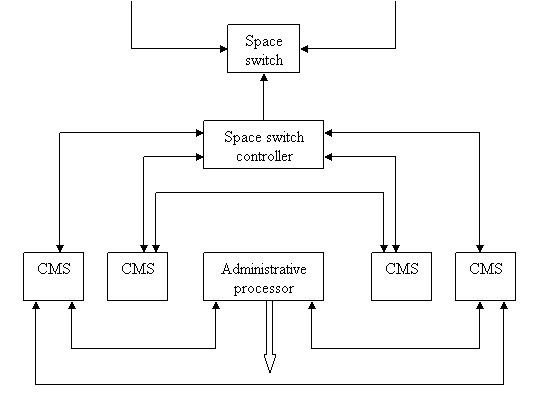
Central module is responsible for space switching of inter-Base Module calls, communication between Base Module and Administrative Modules, clock distribution and network synchronization. For these function central module has a Space Switch, Space Switch Controller, a Administrative Processor and a Central Message Switches CMS(A,B,C,D). In a 32 Base Module configuration , there are 64 bit parallel buses carrying the voice information from Base Module to the Central Module, and also the Switched information in the reverse direction.
The complete control conceptually is shown in following figure : -
Concept Control Scheme for Space Switch
The administrative processor communicates with the IOPs which act like a central storage. Administrative processor is also connected to Central Message Switches CMSA and CMSB through which AP communicates to SSC. The SSC is connected to all the CMSs (A,B,C,D) so as to communicate with all the BMs through these Central Message Switches (CMS_A,B,C,D).
There are two types of Central Module : -
1.CM-XL (Extra Large)
2.CM-L(large)
|
Central Module Large (CM-L) |
Central Module Extra Large (CM-XL) |
|
1.There are one BTU (Base Terminal Unit) and one SSU (Space Switch Unit) 2.The 8 MHz clock may be locally generated at the Space Switch Clock (SSK) card in CM-L. or may be derived by using Network Synchronisation Equipment(NSE) in this. 3. In CM-L,CM provides connectivity to 16 BMs. 4.Each message switch is a high performance message routing block, implemented by using high speed 16 bit microprocessor Motorolla Company (MC). |
1.There are two BTU and two SSU. 2.The 8 MHz clock may be locally generated at the Central Clock (CCK) Card in CM-XL. Or may be derived by using Network Synchronization Controller Card. 3. In CM-XL, CM provides connectivity to 32 BMs. 4.Each message switch is a high performance message routing block, implemented by using high speed 16 bi microprocessor Motorolla Company (MC). |
Each BM interfaces with CM via two 512 channel parallel buses as BUS-0 and BUS-1,each operating at 4 Mbps. These buses carry voice information of 512 termination of the Base Module towards CM. In the reverse direction, after space switching has been done in the Space Switch under the control of Space Controller (SSC), the same buses carry the switched voice information for 512 termination towards BM. Thus, in a 32 Base Module configuration, there are 64 parallel buses carrying the voice information from Base Modules to the Central Module, and also the switched information in the reverse direction.
CM FRAME ORGANIZATION
CM




Space Switch Administrative Central
Switch Processor Message
1.Space Switch Mux 1.Bus Interface 1.CMS A
Demux Card(SSM) Controller(BIC) Card (For TS0,Bus 0)
2.Space Switch 2.Bus interface 2.CMS B
Switch Card(SS) CPU(BIC) Card (for TS0,Bus1)
3.Space Switch 3.Memory(MEM) 3.CMS C
Clock Card (SCK) (For TS1,Bus 0)
(Space Controller Unit) 4.CMS D
1.CPU Card (for TS1,Bus 1)
2. Bus Interface 1.Message Switch
3.Bus Interface Controller Card
Device(BID) Card 2.Message Switch
4.Memory Device Card(MSD)
(MEM) Card
5.Terminal Cards
CM HARDWARE DISTRIBUTION :-
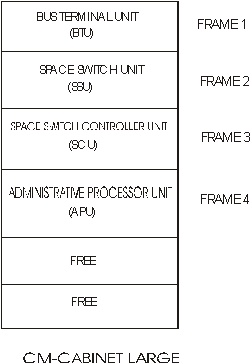
CM Hardware is distributed in following frames : -
- Bus Terminal Unit (BTU) Frame
- Space Switch Unit (SSU) Frame
- Space Switch Controller Unit (SCU)
- Administrative Processor Unit (APU)
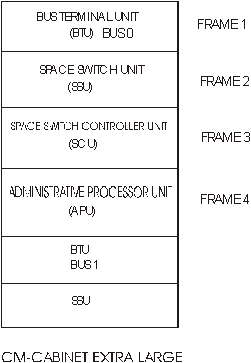
BUS TERMINATION UNIT : -
It contains Multiplexer and Demultiplexer. It is Basically an Interface Unit Between the BM and Space Switch. There are two buses-Bus 0 and Bus 1.Bus 0 contain all even time slots and Bus 1 carries all odd time slots. Bus is terminated from the Base Modulation. It controls the Space Switching between Base Modules.
BTU insert the message CMS to BMS and vice versa.
FUNCTION : -
(a) Caters to maximum 16 BMD in release one.
(b) Multiplexes the data for Space Switching.
(c) De multiplexes the Switched Bus.
(d) Distributed 8 MHz clock and 8 KHz sync. To BMs.
(e) Acts as a Gateway for CMS by message extraction/insertion scheme
Types of cards used : -
1. Space Switch Mux Card(SSM) : - It multiplexes two BMs data.
2. Space Switch Mux Termination Card (SMT) :- It is used in an unequipped. SSM slot in the BTU frame to avoid any noise generated due to termination of a bus from BM in BTU frame. It offer 2A load at 5V.
3. Power Supply Card : - It supplies power to the cards and unit it work as a load sharing mode in each bus.
4. Space switch unit : Space Switch provide connectivity between two subscriber of two different BMs on time slot basis. It is responsible for switching of cards between various base modules
FUNCTION : -
(a) Establishes Inter Base Module Switching.
(b) Caters for 16*16 Base Module switching.
(c) Implements two 16*16 switching; one for bus 0 and other for bus 1.
(d) Provides redundancy as copy 0,copy1(switch duplicated)
Types of cards used : -
1. Space Switch Switch Cards (SSS) : -
The switch card forms the part of the space switch which is situated in the Central Module. Each SSS Card caters for four base modules (16*4 switch in CM).
2. Space Switch Termination Card ( SST) : -
It provides proper termination to the MUX data bus received from 16 space Switch MUX Cards. The card is used if corresponding SSS slot is unequipped.
3. Space Switch CU Bus Termination Cards (SCT) : -
It is used in Space Switch Unit and Space Switch Control Unit frames of CM. It terminates CPU, address, data and control signals.
4. Power Supply Cards : -
SSU employs 4 cards for supplying power and it is used in BPU,TSU,IOP.
3. Space Switching Controller Unit(SCU) : -
It is a CPU complex and interfaces with space switch and clock for controlling the space switch. SSC communicates with the CMSs which in turn enable the SSC to communicate with the BMs. It contain Power Unit
FUNCTION : -
(a) Controller for the Switch
· Time slot management and allocation
· Switch monitoring for sanity
· Switch diagnosis
(b) Communication b/w the central message switch and Aps, BMs
(c) System clock generation
(d) Management of power alarms in BTU,SSU and SCU
Space Switch(SS) and Space Switch Controller (SSC) : -
1. In order to take care of the large number of interface signals, the switch portion of CM is divided into three stages viz. MUX stage, Switch stage and DEMUX stage. The MUX and DEMUX stage are implemented on single card to provide the Base Module to Central Module interface in each direction. Interfacing and switching are controlled by SSC which provides control signals for the MUX/DEMUX cards and the space Switch cards.
2.MUX/DEMUX Cards extract the information from time slots 0 and 1 of Bus 0 and Bus 1 from the Base Modules. These time-slot carry control message from each base Module and these messages are sent to the Central Message Switch (CMS). The CMS sends these message to the Space Switching controller (SSC) on a 128 kbps link to control space switching based upon the information.
3. Four 512-channel buses from four BMs are multiplexed to form a 2048-channel,16Mbps multiplexed BUS which is sent to both copies of the Space Switch Switch Card. Space switching of these 2048 channels is done based upon the switching information received by Space Switch Controller (SSC) from CMS
Central Message Switch (CMS) : -
It consists of four different message switches and each one of them is implemented by using high speed 32 bit microprocessor. All Central Message Switches (CMS 1,2,3 & 4) are used for routing of messages across the Base Modules. Only CMS1 and CMS2 interface with the Administrative Module for routing control message between Base Processors and Administrative Processor.
Type of Cards used : -
1. CPU Complex
· Space Switch Controller Card (SSC) (CPU) : - This is to serve as central processing engine for the C-DOT DSS both in the BM & the CM mode. It coordinates system activities and perform call processing functions. It is used as Base Processor (BP) in the BM& as administrative processor (AP) and Space Switch Controller (SSC) in CM.
· Bus interface-CPU(BIC) Card : - It is used to access memory and space switch in plane copy-0 & copy –1.
· Bus interface Device (BID) Card : - It along with bus interface CPU (BIC) card provides the cross connection b/w duplicate CPU’s (controller) an duplicate device (memory) in such a way that any one failure either at CPU or at device does not bring down the whole processor complex.
· Memory Card (2MB) : -It provides storage space and interfaces to a standard 6800 CPU bus. Both word & byte accessory are possible on the memory space.
2. Switch Interface
· BIC Card
· Bid Card
· Space Switch Controller Termination (SCT)
3. System Clock and PSU errors
· Space Switch Clock Card(SCK) : - It is the source of clock signal to the space switch switch cards & the space switch mux cards which constitute the space switch. It is used for the control of timing and for synchronizing of the space switches.
Administrative Processor Unit (APU) : -
· Status of all module of the exchange is maintained by the AP and whenever a problem is reported required action is initiated to clear the problem. All the global resource like trunks. Time slots etc are managed by the A.P. Directory to equipment number translation for the establishment of a call is performed by AP
All global data is managed by the AP. In a multimodule exchange all the call processing. Administration and maintenance function are supervised by the AP.
Function of APU : -
- All administrative function in the system
- Interaction with SSC through central message switches CMS(A,B) (SSC/BM to IOP via AP).
- Communication to ADP.
- Administrative Processor (AP) somewhat similar to BP.
- Maintain status of all modules of the exchange.
- Initiate whenever a problem is reported required action to clear the problem.
- Switch over of copies, diagnostic of faulty units and put in service units which are out of service etc, are initiated and supervised by the AP.
- Manage all the global resource (like trunks,ts etc.)
- Perform directory to equipment no. translation for the established of a call.
- Connects of exchange to the operator through IOP.
- Handle the man-machine communication.
- During initialization of the multimode exchange AP gather initialization request from different BMs, collects code and data from IOP and send it to corresponding BM’s.
Types of Card used : -
1. CPU Complex (APU)
· CPU Card
· BIC Card
· BID Card
· Memory Card(2MB)
2. Central Message Switch-CMS (A,B,C,D)
- Message Switch Controller Card (MSC)
- Message Switch Device Card (MSD)
CALL PROCESSING
GENERAL CONCEPT
There are five function steps of call processing including the location of the originating and terminating equipment. These steps are : -
· Origination : - Origination begins when the subscriber line goes off hookor incoming trunks seized. It receives the incoming digits, selects the digit analysis tables, and determines the screening information for this call.
· Digit Analysis: - It interprets the digits it receives from origination ,select a destination for each call, and passes the dialed digits to routing.
· Routing/Screening:- Routing uses the destination information from digit analysis and screening information origination to select the terminating trunk group or line.
· Charging : - It uses the charging information from routing to expand the charging data into a formate usable by call accounting process.
· Termination : - The last step in call processing is termination. Termination Processor is different for calls destined for lines and call destined for trunks.
Trunk termination : - A trunk member of the trunks group is selected based on a predetermined pattern. After selection the digits are out pulsed to the distant office.
Line termination : - The line identified in routing is checked to determine the line has any special features. Ringing is applied to the line if applicable or the special feature is activated.
SIGNALING
What is Signaling ?
Signaling refers to the exchange of information between call components required to provide and maintain service.
As users of the pubic Switched telephone network, we exchange signaling with network element all the time. Examples of signaling between a telephone user and the telephone network include. Dialing digits, providing dial tone, accessing a voice mailbox, sending a call waiting tone, dialing *66(to retry a busy number), etc.
Signaling system 7 is means by which element of the telephone network exchange information. Information is conveyed in the form of messages. Signaling System 7 messages can convey information such as :
SS7 is characterized by high-speed packet data, and out-of-band signaling.
OUT OF BAND SIGNALING
Out-of-band signaling is signaling that does not take place over the same path as the conversation.
We are used to thinking of signaling as being in-band. We hear dial tone, dial digits, and hear ringing over the same channel on the same pair of wires. When the call completes, we talk over the same path that was used for the signaling. Tradition telephony used to work in this way as well. The signals to set up a call between one switch and another always took place over the same trunk that would eventually carry the call. Signaling took the form of a series of multi frequency (MF) tones, much like touch tone dialing between switches.
Out-of-band signaling information. This channel is called a signaling links are used to carry all the necessary signaling messages between nodes. Thus, when a call is placed, the dialed digits, trunk selected, and other pertinent information are sent between switches using their signaling links, rather than the trunks which will ultimately carry the conversation. Today, signaling links carry information at a rate of 56 or 64 kilobyte per second (kbps).
It is interesting to note that while SS7 is only used for signaling between network elements, the ISDN D channel extends the concept of out-of-band signaling to the interface between the subscriber and the switch. Win ISDN service, signaling that must be conveyed between the user station and the local switch is carried on a separate digit channel called the D channel. The voice or data which comprise the call is carried on one or more B channels.
Why Out-of-Band Signaling ?
Out of-band signaling has several advantages that make it more desirable than tradition in-band signaling:
· It allow for the transport of more data at higher speeds (56 kbps can carry data much faster than MF outpulsing)
· It allow for signaling at any time in the entire duration of the call, not only at the beginning.
· It enables signaling to network element to which there is no direct trunk connection.
BASIC OF SIGNALING SYSTEM # 7
Common channel Signaling System no.7 (i.e.,SS7 or C7) is a global standard for telecommunication defined by the international Telecommunication Union(ITU), Telecommunication Standardization Sector(ITU-T).The standard defines the procedures and protocol by which network element in the public switched telephone network (PSTN) exchange information over a digital signaling network to effect wireless(Cellular) and wireline call setup, routing control. The ITU definition of SS7 allow for national variants such as the American Nation Standards Institute (ANSI) and Bell Communication Research (bellcore) standards used in North America and the European Telecommunication Standards Institute(ETSI) standard used in Europe.
The SS7 network and protocol are used for :
· Basic call setup, management and tear down
· Wireless service such s personal communications services (PCS),wireless roaming, and mobile subscriber authentication.
· Local number portability (LNP)
· Toll-free(800/888) and toll(900) wireline services
· Enhanced call features such as call forwarding, calling party name/number display,and three-way calling
· Efficient and secure worldwide telecommunication.
Signaling Links
SS7 messages are exchanged between element over 56 or 64 kilobit per second (KBPS) bi-directional channels called signaling links. Signaling occurs out-of-band on dedicated channels rather than in-band on voice channels. Compared to in band signaling out-of-band signaling provides.
· Faster call setup times(compared to in-band signaling using multifrequency (MF) signaling tones)
· More efficient use of voice circuits
· Support for intelligent Network(IN) services which require signaling to network element without voice trunks (e.g., database system)
· Improved control over fraudulent network usage
Signaling Points
Each signaling point in the SS7 network is uniquely identified by a numeric point code. Point codes are carried in signaling messages exchanged between signaling point to identify the source and destination of each message. Each signaling point uses a routing table to select the appropriate signaling path for each message.
There are three kinds of signaling points in the SS7 network.
-
SSP(Service Switch Point)
-
STP (Signal Transfer Point)
-
SCP (Service Control Point)
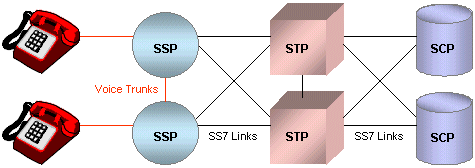
SS7 Signaling Points
SSPs are switches that originate terminate, or tandem calls. An SSP sends signaling message to other SSPs to setup, manage, and release voice circuit required to complete a call. An SSP may also send a query message to a centralized database (an SCP) to determine how to route a call (e.g., a toll-free 1-800/888 call in
North America). An SCP sends a response to the originating SSP containing the routing number(s) associated with the dialed number. An alternate routing number may be used by the SSP if the primary number is busy or the call is unanswered within a specified time. Actual call features vary from network and form service to service.
Network traffic between signaling points may be routed via a packet switch called an STP. An STP routes each incoming message to an outgoing signaling link based on routing information contained in the SS& message. Because it act as a network hub, an STP provides improved utilization of the SS7 Network by eliminating the need for direct links between signaling points. An STP may perform global title translation, a procedure by which the destination signaling point is determined from digits present in the signaling message (e.., the dialed 800 number, calling card number, or mobile subscriber identification number). An STP can also act as a “firewall” to screen SS7 messages exchanged with other networks.
Because the SS7 network is critical to call processing, SCPs and STPs are usually deployed in mated pair configuration in separate physical location to ensure network-wide service in the event of an isolated failure. Links between signaling points are also provisioned in pairs. Traffic is shared across all links in the linkset. If one of the links fails, the signaling traffic is rerouted over another link in the linkset. The SS7 protocol provides both error correction and retransmission capabilities to allow continued service in the event of signaling point or link failures.
SS7 Signaling Link Types
Signaling links are logically organized by link type ('A' through 'F') according to their uses in the SS7 signaling network.

SS7 Signaling Links Types
A link: An “A”(access) link connects a signaling end point (e.g., an SCP or SSP) to an STP. Only messages originating from or destined to the signaling end point are transmitted on a “A” link.
B link: A “B” (bridge) link connects an STP to another STP.
Typically, a quad of “B” links interconnection peer(or primary) STPs (e.g., the STPs from network to the STPs of another network). The distinction between a “b” link and a “D” link is rather arbitrary. For this reason, such links may be referred to as “B/D” links.
C links : A “C”(cross) link connects STPs performing identical function into a mated pair. A 'C' link is used only when an STP has no other route available to a destination signaling point due to link failure(s). Note that SCPs may also be deployed in pair to improve reliability; unlike STP’s however mated SCPs are not interconnected by signaling links
D link: A “D” (diagonal) link connects a secondary (e.g., local or regional) STP pair to a primary (e.g.; inter-network gateway) STP pair in a quad-link configuration. Secondary STPs within the same network are connected via a quad of “d” links. The distinction between a “B” link and a “D” link is rather arbitrary. For this reason, such links may be referred to as “B/D” links.
E links : An “E” (extended) links connects an SSP to an alternated STP.”E” links provide an alternate signaling path if an SSP’s “home” STP cannot be reached via an “A” link. “E” links are not usually provisioned unless the benefit of a marginally higher degree of reliability justifies the added expense.
F link : An “F” (fully associated) link connects two signaling end points (i.e.,SSPs and SCPS). ”F” links are not usually used in network with STPs. In network without STPs, “F” links directly connect signaling points.
ISDN
(INTEGRATED DIGITAL SERVICE NETWORK TERMINAL UNIT)
One of the four ATUs/DTUs in a Base module be replaced by ISTU to provide Basic Rate Interface (BRI)/Primary Rate Interface in C-DOT DSS. It is directly connected to TSU on 8 Mbps PCM Link.
INTRODUCTION
ISDN is comprised of digital telegraphy and data transport services offered by region telephone carries ISDN involves the digitization of the telephone network which permits voice, data, text, graphics ,music ,video and other source material to be transmitted over exiting telephone wires. The emergence of ISDN represent an efforts to standardize subscriber service user/network interface and network and inter network capabilities.
ISDN application includes high speed image application , addition telephone lines in home to serve the telecommuting industry, high speed file transfer and video conferencing. Voice service is also an application for ISDN.
Architecture of ISDN Terminal Unit
In C-DOT DSS architecture the ISDN interface are terminated on a new add on terminal unit as ISTU. A maximum of 256 bearer channels are provided by integrating one ISTU which can be configured to support any combination of BRI or PRI interfaces. If the requirement of PRI/BRI interfaces more than 256 bearer channels ,one or more. ISTU, can be integrated in C-DOT DSS with the option of equipment them in the same BM of distributed across different BMs in the exchange.
The architecture also support in signaling providing time slots for switching channels, carrying data & voice.
SERVICE
There are two types of services associated with ISDN:-
1. BRI
2. PRI
1. ISDN BRI Service
The ISDN Basic rate interface(BRI) Service
offers Two B channels and one
D channels (2b+D). BRI B channels service operated at 64 Kbps and is carry
user data. BRI d channels service operates at 16 Kbps and is meant to carry
control and signaling information, although it support user data
transmission under certain circumstances. The BRP also provides for framing
control and other overhead, bringing its total bit rate to 192 Kbps.
The BRI physical layer specification is International Telecommunication Standard Section (ITU-T). (Formerly the consultative committee for international telegraph and telephone (CCITT)
2. ISDN PRI SERVICE
The ISDN traffic is of two distinct types:-
· Circuit switched voice & data
· Primary Rate Line (PRL)
Basic Rate Line (BRL) Card
The BRL is an interface to the switching system supporting 8 U-interface towards the user. It interfaces with the ISDN Terminal Controller(ITC)/Switching Network for signaling and switching of voice and packet information.
The function of the BRL card include HYBRID for 2 to 4 conversion and echo cancellation monitoring of lines status, it’s activation and deactivation, over voltage protection (for protect the exchange and the BRL card from high voltages),test access.
Primary Rate Interface Line Card(PRL)
The PRL Card is an interface to terminate a 2.048 Mbps link ,using symmetric twisted pair cables with characteristic impedance of 120 ohms.
Each PRL card form a terminal group (TG) and a maximum of 8 PRL, cards can be accommodation in each ISTU.
ISDN USER PART( ISUP )
The ISDN User Part(ISUP) defines the protocol and Procedures used to set-up. Manage, and release trunk circuit that carry voice and data calls over the public switched telephone network(PSTN). ISUP is used for both ISDN and non-ISDN calls. Calls that originate and terminate at the same switch do not use ISUP signaling.
Basic ISUP Call Control
1. When a call is placed to an out-of-switch number, the originating SSP transmits an ISUP initial address message (IAM) to reserve an idle trunk circuit from the originating switch to the destination switch:-
· The IAM includes the originating point code, destination point code, circuit identification code dialed digits and, optionally, the calling party number and name. In the example below, the IAM is routed via the home STP of the originating switch to the destination switch
· Note that the same signaling links are used for the duration of the call unless a link failure condition forces a switch to use an alternate signaling link.
2. The destination switch examine the dialed number, determines that it serves the called party, and that the line is available for ringing. The destination switch transmits an ISUP address complete message (ACM) to the originating switch
· (via its home STP) to indicate that the remote end of the trunk circuit has been reserved. The destination switch rings the called party line and sends a ringing tone over the trunk of the originating switch. The STP routes the ACM to the Originating switch.
· Which connects the calling party’s line trunk to complete the voice circuit from the calling party to the called party. The calling party hears the ringing tone on the voice trunk.
In the example shown above, the originating and destination switches are directly connected with trunks. If the originating and
Destination switches are not directly connected with trunks , the originating switch transmits an IAM to reserve a trunk circuit to an intermediate switch. The intermediate switch sends an ACM to acknowledge the circuit reservation request and then transmits an IAM to reserve a trunk circuit to another switch.
This processes continues until all trunks required to complete the voice circuit from the originating switch to the destination switch are reserved
3. When the called party picks up the phone, the destination switch terminates the ringing tone and transmits an ISUP answer message (ANM) to the originating switch via its home STP
· The STP routes the ANM to the originating switch
· Which verifies that the calling party’s line is connected to the reserved trunk and, if so, initiates billing.
4. If the calling party hangs-up first, the originating switch sends and ISUP release message (REL) to release the trunk circuit between the switch
· The STP routes the REL to the destination switch
· If the called party hangs up first, or if the line is busy, the destination switch sends an REL to the originating switch indicating the release cause(e.g.; normal release or busy).
5. Upon receiving the REL, the destination switch disconnects the trunk from the called party’s line, sets the trunk state to idle, and transmits an ISUP release comlete message (RLC) to the originating switch
· To acknowledge the release of the remote end of the trunk circuit. When the originating switch receives(or generated) the RLC
· It terminates the billing cycle and sets the trunk state to idle in preparation for the next call.
ISUP message may also be transmitted during the connection phase of the call (i.e.; between the ISUP Answer (ANM) and Release (REL) messages.
ALARM DISPLAY PANEL (ADP)
The ADP is used in the C-DOT to display the status of the system in single base module configuration . It can also be used with a two base module system .
The status is displayed on light emitting diodes (LEDs)and seven segment LED display. Fresh faults are reported on the panel by blinking the LEDs accompanied by an audio alarm to draw the attention of the operator in turn is expected to acknowledge the faults .
ADP is a microprocessor based hardware unit which is attached to the BP (in SBM) or AP(IN MBM) by HDLC(HIGH DATA LINK CONTROLLER) link for providing audio visual indication of system faults . a seven segment display shows the count of lines and trunks currently faulty.
ALARM PHILOSOPHY :-
In a C-DOT DSS, there are three categories :-
-non urgent => green LEDs .
-urgent => orange LEDs .
-critical => red LEDs .
FUNCTIONAL DESCRIPTION :-
The ADP is housed on three cards :-
- Controller card .
- display card .
- power supply card .
1. Controller card :-
It is a subdivided into following blocks:-
(a) CPU LOGIC :-
It generates clock required by microprocessor, buffers for buffering for CPU address and data bus , power on reset logic to generate the signal.
(b) MEMORY :-
Occupies address space RAM.
(C) DISPLAY CARD INTERFACE :-
Consist of logic which generates the various strobes for the registers on the display card
(D) INTERRUPT AND WATCHDOG DOG :-
The sources of interrupt for the CPU are :-
(i) Real time timer
(ii) Acknowledge switch
(iii) LED test switch
(iv) The two HDLCs.
The sources for generate one interrupt line for the microprocessor.
(e) INPUT /OUTPUT PORTS AND AUDIO ALARM :-
input port is used to determine the configuration of the system and the source of the interrupt. Output port is used for cleaning the various interrupts & for enabling the audio alarm. The audio alarm is implemented using a piezo-electric buzzer
(f) COMMUNICATION INTERFACE:-
Consists of clock generator for the HDLs.
INTERCONNECTION
Various interconnection required in the ADP are as follows :-
1. link connection: The two links from the two copies of BPs are terminated on the back panel.
2. Controller card to display card connection : This connection is made with a 34 pin flat cable also carries the power for the display card .
3. Power connection from power supply card to controller card : A four wire cable connect the power from the power supply card to controller card through four pin connector.
4. Connection for switches and beeper => switches => Reset switch
LED test switch Acknowledge switch
connected through twisted pair wires.
5. 48V connection to power supply card =>
48V from the exchange battery is the ADP through a two pin power connector that passes through a power ON/OFF switch .
SYSTEM CAPACITY
INTRODUCTION
The capacity of C-DOT DSS is defined in terms of the following parameters:
· The termination capacity express as the number of lines and trunks
· The amount of traffic (in erlangs) that can be switched
· The number of Busy Hour Call Attempts (BHCA) that can be processed with a given call-mix while meeting the overall service quality requirements.
This section indicates the maximum capacity of different system element as well as that of complete exchange, equipped to its ultimate termination capacity. It has been ensured that the specified parameters are valid to meet overall reliability objectives for the C-DOT DSS as specified in ITU-T recommendation.
TERMINATION CAPACITY
A terminal Card is the basic system element. It interfaces/terminates the lines and trunks. The next higher element is a Terminal Unit. The types of terminal card and terminal unit used in C-DOT DSS along with its function are already explained in chapter ‘3’ &’4’. Termination capacity of BM is 488 analog lines and that of LM in 768 analog lines. A BM can be concentrated with 2 LM’s to provide maximum termination capacity of 2024
Analog lines. Incase of BM, a maximum of 256 B channels are provided at the cost of 512 analog lines. One to one replacement of Base channel is planned in immediate future. Base Module and Line Module are the highest level of system elements. Each Base Module has four Terminal Units whereas a Line Module has six Terminal Units.
A maximum of 16 BMs can be connected in MAX-L and 32 BMS can be connected in MAX-SL configurations.
Table summaries the termination capacities of the various system element of C-DOT DSS MAX.
|
S.NO. |
SYSTEM ELEMENT |
TERMINATIONCAPACITY DESCRIPTION |
|
1 |
TERMINATION CARD |
|
|
1.1 |
Analog Line Card |
LCC-8 analog subscribers |
|
|
|
CCM-8 CCB subscriber with last two |
|
|
|
ports supporting16 KHz metering pulse |
|
1.2 |
Analog Trunk Card |
TWT or EMF -8 Trunks |
|
1.3 |
A set of DTS/DTC Cards |
One,2 Mbps E-1 link as CAS/CSS7 trunks |
|
1.4 |
#7 PHC Card (SHM) |
8 Nos. protocol handlers/signaling links |
|
1.5 |
ISDN-BRI Cards |
8BRI (2B+1D) interface I.e. 16 Bearer Channels |
|
1.6 |
ISDN-PRI Cards |
One PRI (308+D) interface I.e. 30 Bearer Channels |
|
2 |
TERMINATION UNIT/FRAM |
|
|
2.1 |
Analog TU (ATU) |
16 analog terminal cards(LCC,CCM,EMF,TWT) to |
|
|
|
support any combination of lines and Trunks in |
|
|
|
multiple of eight termination |
|
2.2 |
Digital TU (DTU) |
4 Nos. 2 MbpsE1 links asCAS/CSS7 |
|
2.3 |
#7Signalling Unit Module (SUM) |
64 Nos; 37 protocol handlers/signaling links |
|
2.4 |
ISDN-Terminal Unit (ISTU) |
256 Bearer channels to be configured as BRI, PRI |
|
|
|
or any combination of them. |
|
3 |
BASE MODULE/RACK |
|
|
3.1 |
Link Module(line) |
480 analog subscribers. A maximum 256 Bearer |
|
|
|
Channels for ISDN interface can be provided at the |
|
|
|
Cost of 128 subscriber lines. |
|
3.2 |
Line Module |
768 analog subscribers. A maximum of two line |
|
|
|
module connected with Base Module support |
|
|
|
2024 Lines |
|
3.3 |
Base Module(Analog Trunks) |
488 analog trunks |
|
3.4 |
Base Module (Digital Trunks) |
15 Nos., 2Mbps E1 links as"CAS/CCS7 |
|
3.5 |
Base Module (Analog+ Digital) |
Three possible configuration as 360 AT + 4 |
|
|
|
PCMs, 232+8PCMs or 104AT + 12PCMs. |
EXCHANGE CONFIGURATION
C-DOT DSS MAX can be configured to support any combination of lines and trunks, for different application in the network as local Exchange, Local cum Tandem Exchange. Trunks Automatic Exchange(TAX) or Integrated Local cum Transit (ILT) Exchange.
In this maximum configuration, upto 40,000 lines and 5,500 trunks are supported when configured as Local/Local cum Tandem. When configured as TAX. 14,500 trunks are supported.
Termination Capacity of Exchange Configuration
|
S. No. |
Exchange Configuration |
Termination Capacity Description |
|
1.
|
Single Base Module(SBM) |
1500 lines and128 trunks. The trunks may be analog and/or digital. The no. of trunks can be increased at the cost of reducing subscribers. |
|
2.
|
Multi Base Module (DSS-MAX) (i) MAX-XL |
Ideal configuration to support 40,000 lines and 5500 trunks with 20 line BMs and 12 Trunks BMs. The trunk capacity can be increased by 450 at the cost of 2,000 subscriber or vice versa |
|
(ii) MAX-L |
Ideal configuration to support 20,000 lines and 2700 trunks with 10 line BMs and 6 Trunk BMs. The trunk capacity can be increased by 450 at the cost of2,000 subscriber and vice versa. |
|
|
3. |
Remote Switching Unit (RSU) |
2,000 Subscriber Lines. Trunk interface at the cost of subscriber lines. |
|
4 |
Multi Base Module TAX |
14,500 Trunks |
Note : Out of the total equipment capacity, a maximum of 30,000 Lines may be Remote Subscriber through RSUs in MAX-XL whereas 14000 lines.
SOFTWARE ORGANIZATION
The software is written in high level language ‘C’ & distributed over various processors and is structured as a hierarchy of virtual machines. The software features are implemented by communication processes. The operating system provides communication facilities such that the processes are transparent to heir physical locations.
Resource are identified as ‘global’ or ‘local’ depending upon their distribution in the system. The resource which depends upon the number of terminal are provided within the basic growth module. The basic module processor are provide for handling call processing locally. In a small system application , these processor independently support call processing, exchange operation and maintenance functions. Central facilities are also provided to avoid repetition of large data & memory intensive functions.
E.g., Processor architecture is characterized by distributed control & message based communication in order to achieve a loosely-coupled network for a flexible system architecture.
ROLE OF SOFTWARE IN C-DOT DSS
INTRODUCTION
The main feature of the software architecture of DSS-MAX are as:
- Distributed architecture to ma the distributed control architecture
- Layered architecture with loosely coupled modules & well defined message interfaces.
- Use of high level language
- Modular design with each layer providing higher of abstraction
- Time critical processes in assembly language
These feature help in to achieve the following objectives:
- Simplicity in design
- Increased reliability due to fault tolerant software
- Flexibility with option of up gradation to add feature & service
- Efficiency and strict time check
- Ease of Maintainability

C-DOT DSS MAX Layered Software Architecture
SOFTWARE SUBSYSTEMS
The main subsystem of C-DOT DSS MAX are as :
- C-DOT real Time operating system
- Peripheral Processors subsystem
- Maintenance subsystem
- Database subsystem
- Administration subsystem
- IOP subsystem
- Call Processing subsystem
These subsystem are responsible for providing the following basic services:
1. CDOS :
It is the operating system & provides the following function :
- Process management
- Resource management
- Interrupt handling
- Online & offline debugging
2. Peripheral Processor subsystem :
It controls all the telephony software. It also carries out the commands given by the Base Processor for generating suitable telephony events. Another function is to carry out all the maintenance related test function on hardware. It consists of 8-bit microprocessors programmed in assembly language
3. Call processing subsystem:
It receives the information about telephony event that occur outside the exchange. It processing this incoming information & gives commands to the peripheral processors for interconnecting subscriber through the switching network. A special feature is to generate Exhaustive Call Event Record for every call.
4. Maintenance subsystem:
It provides the following function:
· Initialization
· System integrity
· Switch maintenance
· Terminal interface
· Human interface
5. Administration subsystem:
It consist of traffic, billing exchange performance measurement & human interface functions. It also provides online software patching capability. It is responsible for maintaining a large number of traffic records on the basis of information received by it through Call Event Records. Over 200 man-machine commands are provided for these operations.
6. Database Subsystem:
It provides for the management of global data.
The main objectives are:
(a) Easy access
(b) Quick access
(c) Transparency
(d) Consistency
(e) Security
(f) Synchronization
BASIC SERVICE IN DSS MAX
The most important function of a DSS switch is to process subscriber calls. Subscribers’ call can be classified as line-to-line, line-to-trunk, and trunk-to-trunk. A lint-to-line is a call that starts on a line served by a DSS switch and terminates to another line served by the same switch. The BMs involved in the call will perform almost 95% of the total call processing function.
During a line-to-line call, the origination BM detects when a subscriber’s telephone receiver as been picked up. The BM provides the dial Tone and then removes the Dail
Tone when first digit is dialed. It then collects and analyzes the dialed digits. Next, the BM sends a request to the AM for a call path. The terminating BM locates the subscriber line for the line-to-line call and provides ringing.
When AM has selected an available path. It alerts the CM to set up link between the BM’s. The CM provides call paths between BM’s and carries all internal system communications.
The function of BM, AM, and CM in trunk-to-trunk call are basically the same as line-to-line call described above except that the originating BM detect a trunk seizure rather than a subscriber picking up the receiver. Also, the terminating BM locates as available trunk instead of line.
The above scenarios may differ slightly, if the call involves both and trunk.
Lint-to-Line call can be of two types:
· INTRA_BM: When both subscriber lines connected to same BM. This doesn’t require use of CM.
· INTER_BM: When both subscriber lines are to different BMs. This requires use of the CM.
OTHER SERVICE PROVIDED BY MAX
The MAX provides the following features apart from processing of a telephone call:
Number identification Service:
- Calling Line Identification Presentation (CLIP): The Calling Party’s details are given to the user along with the incoming calls.
- Calling Line Identification Restriction(CLIR): With this service the calling party may restrict presentation of it’s number to the called party.
- Calling Line Identification Restriction Override (CLIRO): The subscriber with this facility receives the details of the calling party even if it has asked for it’s restriction.
- Malicious Call Identification (MCID): During conversation the subscriber can use a procedure to identify the malicious caller.
Call offering supplementary Service:
· Call Forwarding ?Unconditional(CFU)L It allows the user to forward all incoming calls to another number.
· Call Forwarding Busy(CFB): It allows the user to forward all incoming calls to another number if the user’s number is not free.
· Call Forwarding No Reply (CFNR): It allows user to forward all incoming calls to another number if the user doesn’t respond in a fixed number of rings.
Call completion Services:
- Call Waiting: A Subscriber engaged in a call, is given an indication that another caller is trying to call him up. The user can then talk to a caller by keeping the other holding.
- Call Hold: This allows the user to put th call into wait for the being and initiate or accept a new call. The user can retrieve the call put on hold whenever required.
Multi Party Services:
- Three Party Conference: It enables the user to establish, participate in and control a simultaneous communication involving the user and two other parties. The served user can disconnect one party, disconnect the three-way conference or communicate privately with one of the parties.
- Multi Party Conference: It allows uses to establish and control a conference involving at the most 6 users. The conference controller may add, drop, isolate, and reattach parties from the conferences.
Misc. Service:
- Hot Line(Timed): It allows the subscriber to establish calls to a pre-registered number. After getting the dial tone, if the subscriber doesn’t dial any number for a minimum amount of time, then he is connected to the pre-registered number. If the subscriber dials a number, then normal connection is established.
- Hot line(Without Time-Out): As soon as the subscriber lift the handset, the call to the pre –registered number is established. Normal outgoing calls can’t be made.
- Reminder Call/Alarm Services: The subscriber can receive a call by the exchange at a specified time. This service is available in two forms: (i) Semiautomatic Form ,where the booking is manual through an operator, or (ii) Automatic Form, where booking is done automatically, through a control procedure.
- Subscriber Controlled Call Restriction Service : In this service; the user can deny all call at a time deny various levels of originations from a line. Outgoing calls can also be restricted by the mean of a password.
- Instruction Barring Service: With this service a subscriber can enjoy an uninterrupted call, e.g., in case of data transmission.
POWER PLANT OF C-DOT DSS MAX
From the power supply bus bar power is tapped through cables to each suite separately. In this there is five modules, each having 200amp. As input. In this, AC is input and DC is output. In this input is between 340-475 V and output is 48V. There are two batteries if one is not conduct than other is used. These are connected together if both are disconnected than till 15-20 minutes power is supplied. From the rectifier, which derives 48V DC from 440V AC. Power cables are terminated on the DC distribution panel (DCDP). From the DCDP, power cables run along the cable runways and ladders and terminated on the power distribution panel(PDP). Distribution panel consists of two bus bars for –48V, one each for copy 0 and copy 1 equipment. Similarly there are two bus bars for ground.
For each base module cabinet, the power i.e.-48V is tapped twice one for each plane through a fuse. Whenever the fuse blows off the LED, which is connected in parallel glows on the FBI card, and an audio alarm is given at a centrally located point.
SUMMARY
C-DOT DSS is a modular and flexible Digital Switching System which provides economical means of serving metropolitan, urban and rural environment. It incorporated all important feature and mandatory service, required by the user with option of up gradation to add new features and service in future. The architecture for the C-DOT DSS is such that it is possible to upgrade a working C-DOT SBM or MBM exchange to provide ISDN service by adding minimum addition hardware modules while retaining existing hardware units.
C-DOT DSS MAX is a universal digital switch which can be Configured for different application as local, transit, or integrated local and transit switch. The design of C-DOT DSS MAX has envisaged a family concept. The advantages of family concept are standardized components, commonality in hardware, documentation, training, installation and field support for all product and minimization of inventory of spares. Infact this Modular design has been consciously achieved by employing appropriate hardware, software, and equipment practices.
Software is written in high level language ‘C’ and distributed over various processor and is structured as a hierarchy of virtual machines. It can be distributed over appropriate controllers. The Software failures are implemented by communicating processes.
REFERENCES
· C-DOT Library
· C-DOT DSS MAX General Description
· www.cdot.com
· A Book Digital Switching System by Sayed Ali
Contribute content or training
reports / feedback / Comments
Practical
Training reports
All rights reserved © copyright
123ENG